
Surface Blasting Services is very proud of its safety record. When using explosives there are three main criteria to consider:
(a) Ground vibration
(b) Fly Rock
(c) Air Blast
Surface Blasting Services moves onto site with our drilling equipment. The burdens and spacing of the drill holes will vary according to the depth of the holes and the type of blasting to be done i.e. trenching, road cutting, boulder blasting etc. The holes will be marked by a qualified blaster who will also supervise the drilling. After all the drilling has been done we will obtain blasting and transport permits from the SAPS. We inform the Inspector of Explosives the amount of explosives to be used and the distance from the explosive magazines (place where explosives are stored) to the blast site. The vehicles used to transport explosives have to comply with the specifications set down in the Explosives Act. The vehicles are equipped with 9kg DCP lire extinguishers which are inspected monthly. On the day of the blast, the blaster with his permits, will draw explosives and proceed to the blast site. The explosives are carried in special locked up aluminum boxes. On site the blasting boards will be placed around the blast area. The blaster will then charge up the drilled holes.
GROUND VIBRATION
When blasting close to private property the maximum peak particle velocity is 25mm per second. Example – a house 15 meter from the blast, we are allowed 4.5kg of explosives between each 25mm second relay. One stick of explosives 25 x 200 Energex weighs 0. 11 kg, therefore you are allowed 40.90 sticks between each relay as to be within the limits of 25 mm per second.
By using this method there would be no damage to private property. Should the contractor require a vibro recording to be done, we will employ an independent company to set up monitoring equipment to the nearest house from the blast area. The cost of the vibro is for the contractors account.
FLY ROCK
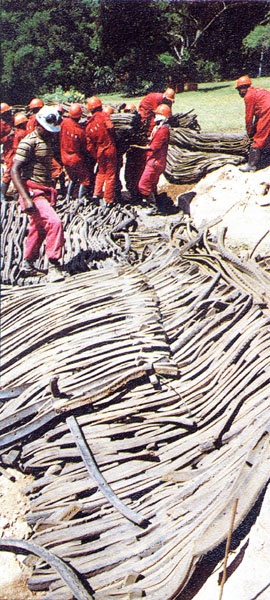
There are two methods to curtail fly rock. One is by placing rubber blasting mats on the blast area. The other is to place sand on the blast area to a depth left to the discretion of the blaster.
AIR BLAST
The detonating fuse on the surface of the blast detonates at 22000 Feet per second thus causing air blast. The way to curtail the air blast is to cover the surface detonating fuse with sand. Once the blast has been charged up the blaster will then send his staff with red flags to remove all persons and animals to a safe distance. The blaster will then personally visit the flagmen to ensure the area is safe. He will then attach the detonator to the detonating fuse. The blast is set off by an electric shot exploder attached to a blast cable, a safe distance from the blast. The blaster will only fire the shot once he is satisfied that the area is safe and has contact with all his flagmen. Once the shot has been fired the blaster will then visit a blasted area to check that all the shots have gone off. Once he is satisfied he will then declare the area safe. No storage of explosives is permitted on the site.
All the requirements of the Explosives Act are followed. All staff are provided with protective clothing; i.e. goggles, earplugs, masks etc. The Inspector of Explosives is advised before 9.00 hours of the expected time of the blast. He will visit our sites regularly to make sure that all safety precautions and regulations are adhered to